Enterprise software development is at an inflection point. AI made building software feel different. Radically different.

Amitabh Sharan
4 minute read
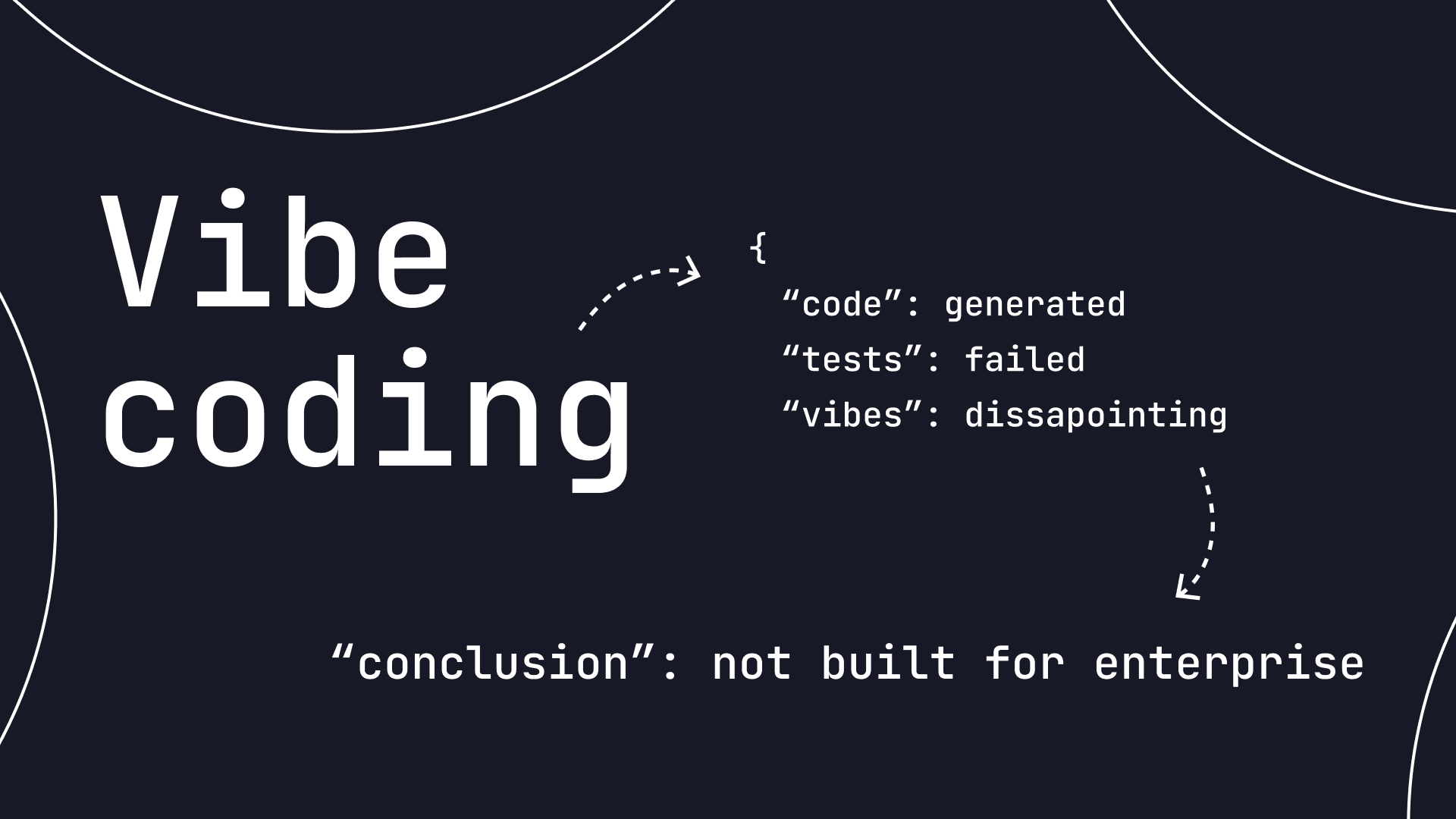
Enterprise software development is at an inflection point. AI made building software feel different. Radically different. Type a prompt, get a working application in minutes. The demos were impressive. The speed was real. The hype followed.
But IT leaders know the difference between a demo and a production system. And the more closely you look at the tools riding the vibe coding wave, the clearer that difference becomes. Before we get into dissecting the reality of vibe coding tools, it is important to note that these tools have certainly ushered a paradigm shift in the space. While they may not be the all-in-one solution for enterprise software, they have forever changed the way businesses envision development.
Two categories of AI tools have dominated the conversation. The first is vibe coding platforms: tools such as Lovable, Replit, and Bolt that let anyone generate and deploy a working app from natural language, no code required. The second is AI coding assistants like GitHub Copilot, Cursor, and Claude Code: tools that sit inside developer environments and help engineers write code faster.
Both are impressive. Neither was designed for enterprise software from the ground up.
Something new is starting to fill that gap (More on that later).
Who these tools were actually built for
Vibe coding platforms were designed for a specific job: prototyping. Getting an idea out of someone's head and into something clickable, fast, without waiting for a development sprint.
For that, they work reasonably well.
A product manager can spin up a proof of concept in an afternoon. A founder can validate an idea before hiring a developer. A small team can build an internal tool without raising a ticket.
That is genuinely valuable. The problem is not the tools themselves. It is what happens when enterprises use them for something they were not designed for: production software that handles real data, connects to real systems, and operates under real compliance obligations.
AI coding assistants sit in a different category. They are built for professional software engineers. Cursor, for example, is reportedly used by over 64% of Fortune 500 companies, almost entirely within engineering teams. A trained developer is in the loop, reading and validating the code before it goes anywhere near production.
That assumption breaks down the moment the person building is not an engineer.
The governance challenges that matter
Let me be direct about what actually goes wrong when vibe coding tools land in enterprise environments.
The build process has no safety gates
Traditional enterprise software goes through a structured process: code review, security scanning, testing, approval, and then deployment. Vibe coding platforms compress all of that into one step. Prompt to live application. There is no review gate built into the flow. What gets generated goes live, fast.
The output is also hard to hand off. AI-generated codebases tend to be tightly coupled around the platform's own conventions, which makes them difficult for your engineering team to pick up, review, or maintain over time.
Credentials end up in the wrong places
When a non-technical builder needs an external integration to work, they do what makes sense in the moment: they paste the API key into the prompt. That credential tends to end up in session histories, in the generated code, or in a public repository. Security researchers have documented this pattern extensively across vibe-coded applications. The tools prioritize making the integration work. Security hygiene is not part of the prompt.
Compliance is your problem, not the platform's.
This is the one that catches enterprises off guard.
A platform can hold SOC 2 and ISO 27001 certifications and still not make your application compliant. The certification covers the hosting environment. Your application logic, your data handling, your regulatory obligations: those are yours. Some vibe coding platforms explicitly prohibit processing regulated data categories in their terms of service and disclaim responsibility for violations if that data is submitted.
Data also defaults to US-based cloud infrastructure in standard configurations, which creates legal exposure for companies with EU data obligations. With the EU AI Act's General Purpose AI provisions entering full enforcement on August 2, 2026, this is no longer a risk to defer.
Shadow IT now has a much faster engine
Vibe coding tools are easy to use. That is the point. And it is exactly why they spread beyond IT's line of sight. A team can build, publish, and connect an application to real company data without going through identity verification, security review, or architecture approval.
IT may have approved the platform. It almost certainly has not approved every application being built inside it.
The result is app sprawl. Applications accumulate across the organisation with no central inventory, no ownership records, and no way to know what any of them are connected to. IT cannot govern what it cannot see. And by the time a problem surfaces, whether that is a data breach, a compliance audit, or simply a question about what is running on company infrastructure, the answer is often: nobody knows.
Ownership is murkier than it looks
Standard terms for vibe coding platforms deliver AI-generated output "as is," with no guarantee it is free of third-party intellectual property. Some platforms retain the right to reclaim the subdomain your application runs on, at their discretion, without compensation.
For a prototype, that is an acceptable risk. For a business-critical system, it is not.
What about AI coding assistants?
AI coding assistants are a better fit for enterprise environments. But they come with their own catch: they are governed by configuration, not by default.
Out of the box, most are optimized for developer speed. Getting to an acceptable security posture requires IT teams to actively configure single sign-on, model access policies, context-exclusion rules, and automated execution controls. In practice, most organizations deploy them without those safeguards in place. Individual developer settings become the de facto governance layer.
There is also a context risk. Coding assistants index local codebases to generate relevant suggestions. Without proper configuration, environment variables, SSH keys, and proprietary business logic can be transmitted to external model providers as part of that process. Data retention policies vary significantly across tools and pricing tiers.
Coding assistants are the right tool for professional developers who need to move faster. They are not a governance solution. They shift the compliance burden entirely to engineering teams.
The incumbent alternative: governed, but not built for this moment.
Before vibe coding, enterprises that wanted to build faster turned to low-code platforms. Tools like Mendix, OutSystems, and Appian offered real governance, real integrations, and real security controls.
They still do.
But they were designed for a different era. Building is slow. Costs are high. Vendor lock-in is deep. And AI is an addition, not a foundation. You can feel it.
So enterprise IT leaders find themselves in an uncomfortable position. The tools that move fast lack governance. The tools that have governance do not move fast, and were not built for AI.
Neither option was designed for where we are now.
A new category is taking shape
What enterprises actually need is not a choice between speed and control.
A new category is emerging: AI Application Generation. Not vibe coding with governance added as an afterthought. Not traditional low-code with AI bolted on. Something purpose-built for how enterprise software needs to work.
Betty Blocks is building in this space. The framework comes down to four non-negotiables.
Prompting. Natural language as the primary way to build. Accessible to business users and developers alike, without giving up the structure that enterprise applications require.
Controlling. Governance built into the platform itself, not configured on top of it. Role-based access, approval workflows, audit trails, and compliance controls that apply to everything built on the platform.
Connecting. Real integration with the systems that already exist. Not new data silos, but software that works with existing data models, APIs, and business logic.
Owning. Your code. Your infrastructure. Your hosting choices. No subdomain risk. No IP disclaimers. No lock-in to a runtime that makes migration expensive.
These are not aspirational principles. They are the minimum requirements for enterprise software in 2026.
We are hosting a webinar on 9 July 2026: The Four Pillars of AI App Generation. We will walk through what each pillar means in practice and what enterprise-ready AI app generation actually looks like.
Reserve your spot: https://bettyblocks.com/webinars/the-four-pillars-of-ai-app-generation