AI development approaches compared
Vibe coding, AI coding agents and AI Application Generation all use generative AI, but they optimize for different outcomes. Vibe coding typically accelerates idea-to-prototype. Coding agents help developers change, test and ship code. AI Application Generation is designed to turn business intent into applications inside a governed delivery model.

The short answer
Vibe coding is a way to build by prompting. AI coding agents are developer tools that act on code. AI Application Generation is a platform approach for generating applications inside a broader governed lifecycle.


The core differences
Same AI shift. Different job to be done.
The categories overlap, and some products span more than one. Compare them by the job they are designed to do, not simply by the fact that they use AI.
Three approaches
What each approach actually produces
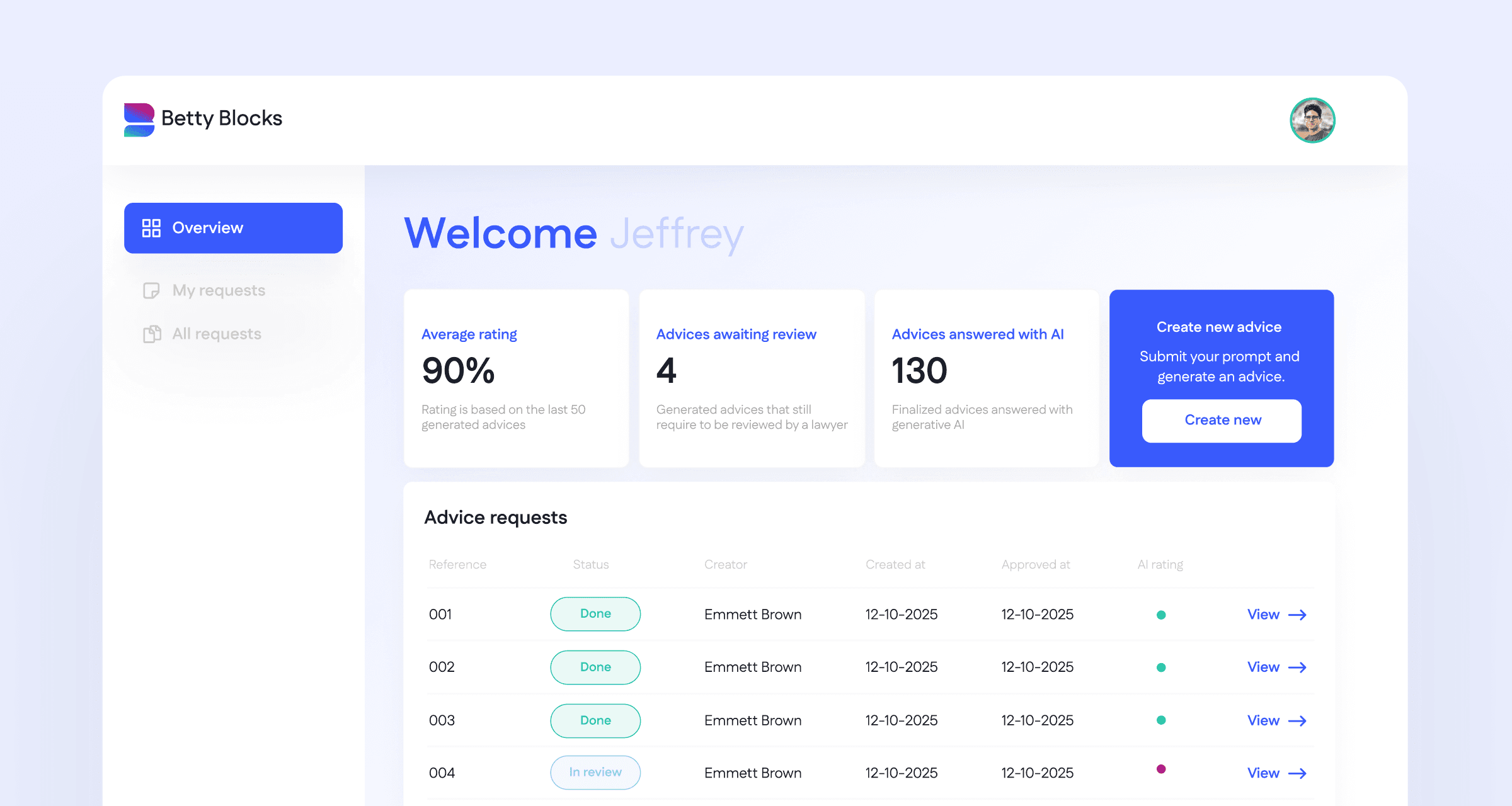
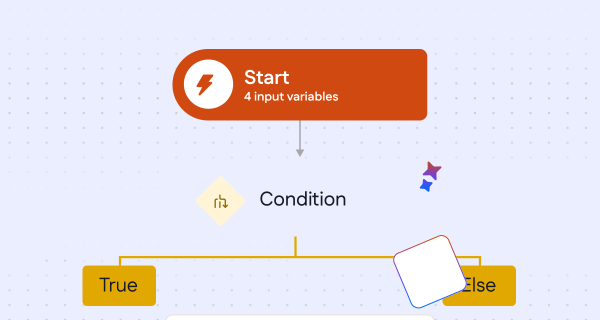
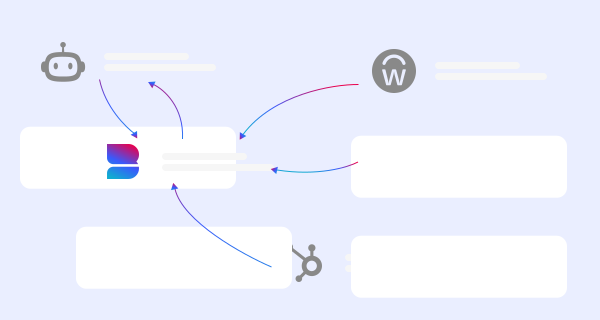

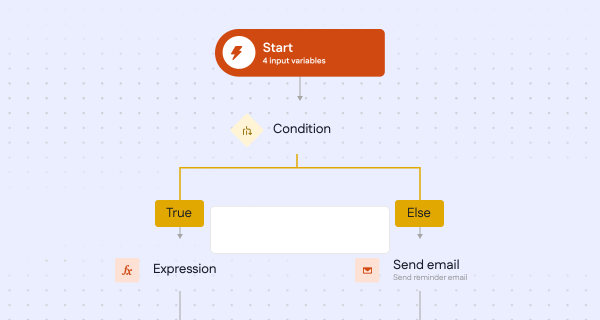
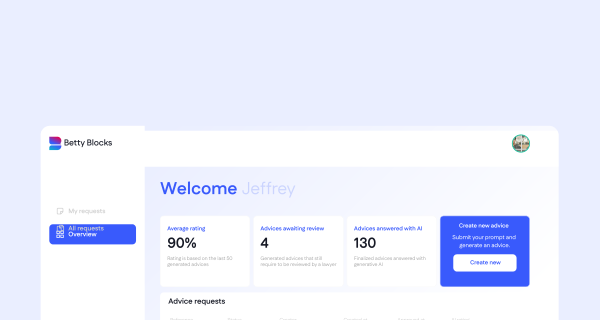

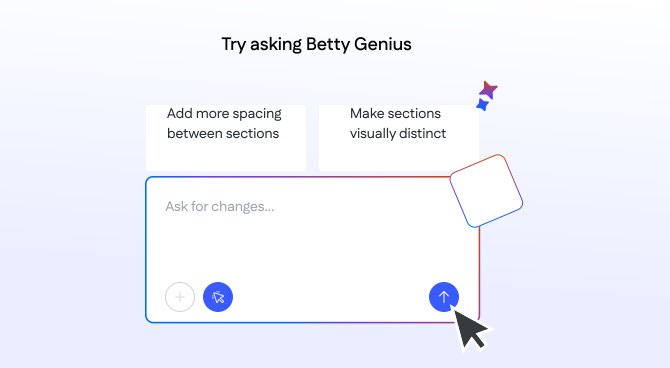

AI tools comparison
AI coding tools are a governance nightmare. Traditional low-code platforms slow you down and lock you in. Custom development gives full control and leaves knowledge with the developer who wrote it. Betty Blocks is the only platform where speed and control go hand in hand.
Category
Vibe coding tools
AI Coding Agents
Platform extensions
AI Application Generation
Custom Development
Key players
Lovable, Base44, Cursor, Replit
Claude Code, GitHub Copilot, ChatGPT
Mendix, OutSystems
Power Apps, ServiceNow, Salesforce
Betty Blocks
Internal teams, agencies
Core strenght
Speed to prototype, low barrier to entry
Developer productivity, broad capability
Enterprise governance, compliance track record
Deep ecosystem integration
AI-native architecture. Governed. Open.
Full control, no vendor dependency
Core weakness
No structural persistence, no governance, full app rebuild on re-prompt
Developer-dependent; no deployment or governance layer
AI as IDE accessory; proprietary runtime lock-in; limited code export
Vendor lock-in; external user licensing costs; limited cross-system scope
Emerging category; buyer education required
Slow to production; knowledge leaves with developers
Frequently Asked Questions
Got questions?
We have answers.
Is vibe coding the same as using an AI coding agent?
No. Vibe coding commonly describes a way of building software by describing the desired outcome and iterating on AI-generated results. An AI coding agent is a tool that can take software-engineering tasks, work against files or repositories, run development tools, and return implementation work. You can use an agent in a vibe-coding style, but the concepts are not identical.
What is an AI coding agent?
An AI coding agent is designed to carry out software-engineering tasks with more autonomy than simple code completion. Depending on the product and permissions, it can inspect a codebase, edit files, run commands or tests, and prepare changes for human review.
What is AI Application Generation?
Betty Blocks uses AI Application Generation to describe a platform approach where business intent is turned into applications inside a broader application lifecycle. The important distinction is that buyers evaluate not only generation, but also governance, integrations, deployment, maintainability and ownership.
Which approach is best for enterprise application development?
It depends on the job. Vibe coding can be useful for rapid exploration and prototypes. Coding agents can materially accelerate professional development work. An AI Application Generation platform is most relevant when the organization wants generation to sit inside an application-delivery model with enterprise controls. Test each approach against a real use case rather than choosing by category name alone.
Can enterprises use vibe coding safely?
Potentially, but the label itself does not make a workflow safe or unsafe. Enterprise teams still need to evaluate access controls, code and architecture review, testing, data handling, release processes, auditability, maintenance and ownership before production use.
Does AI Application Generation replace developers?
No. It changes where manual work happens. Technical teams can still be responsible for architecture, integrations, security, review and production requirements, while AI accelerates the generation and refinement of the application.